Saturday, June 28, 2014

Conferencing 101

After completing my 3rd year as a doctoral student, and 2nd year full-time, I have been to many conferences. I've been to local, regional, state, and national conferences, both research- and practitioner-focused. 

When I went to my first conference, I was so nervous I couldn't stand it. Now, I don't get very nervous, but I've learned a thing or two to make sure I get the most out of the conference, while still networking and having fun. 

Here is my Conferencing 101 based on what I have learned and tried at conferences! 

1. Conferences are for networking. There is no way around this one. The point of a conference is to share your ideas with others and learn from their ideas. It's all about talking to people! Therefore, it is important to attend conferences armed with business cards to share. If you are presenting, have some kind of material to physically share with people who attend your presentation (e.g., an online file-sharing, handouts of slides, handouts of activities and documents, a copy of your research paper). People will return home, unpack their bag, and find your business card or materials then reach out to you again.


2. View the program ahead of time. If the program and schedule are available online, view them before getting to the conference. If they are not available online, carve out about 30 minutes once you get to the conference to view the program. Use this time to look for certain people on the program that you want to meet (e.g., people who do similar research as you, or if you are looking for a job, people who work where you are applying). Also, look for several sessions that you want to attend. It is not necessary to attend every single session on the program, but you want to attend a few each day. Pick sessions that interest you, align with your research, present research contrary to your own, or deal with new policies or methodologies. Take this time to learn and expand what you know as well as learning about your own interest more.


3. Get a mentor. I have now attended two conferences in which I got a mentor, and I have loved it! The experience of getting to talk to someone with a new perspective can be enlightening. Usually, you will schedule a short period of time (20-30 minutes) to meet with your mentor. You can ask this person for advice, questions, or just chat about the conference and what is happening in your field. These people also become great networking advantages as they usually know more about the conference and more people who attend. 


4. Take advantage of workshops. I've attended several workshops at different conferences I've attended and they are usually very rewarding. Experts in the field host these workshops and oftentimes provide handouts and documents that can be referenced later. Many workshops in my field relate to methodologies, writing, or managing time. While some of the topics are familiar to me, it can be refreshing and motivating to hear about them from a new perspective.


5. Enjoy the travel! I am a firm believer in working hard, playing hard. Academics work extremely hard and that includes time at conferences. Many conferences are held in interesting cities and historical locations; therefore, take advantage of the travel opportunity! I always plan at least one day of a conference to go sight-seeing in the city and enjoying being in a new place. This includes visiting tourist attractions, learning at museums, and enjoying yummy food. This part of conferencing is just as important as the networking opportunities. 


6. Attend the social events. Most conferences have networking opportunities as social events. These can be awards lunches, planned dinners, happy hours, receptions, or breakfasts. This is where the informal chats happen, and there is usually free food and beverages (sometimes alcoholic). It is important to be seen at these events because people who have met you will look for you there, and you get an opportunity to talk in a non-academic setting. You can share ideas, ask questions, or mingle freely. 


7. Do a few things on your own. Most people travel to conferences with at least one other colleague. While it is nice to have someone to travel with and attend conference events, it is important to step out and go to a few events alone. By going to a session by yourself, you are forced to talk to different people, sit next to different people, and share new ideas with someone you do not already know. This can be very empowering and brings the focus back to networking with new people. 


8. Plan questions. As I am reviewing sessions I want to attend or planning out meetings with different people, I always prepare a few open-ended questions. These can be related to specific topics in your field or more broad ideas about policy or research. As a doctoral student, I also ask questions about conferences, publications, presentations, dissertation, and job-searching. Having these questions readily available ensures that I never meet someone without being ready for conversation. It also shows an attention to detail and a thirst for knowledge. 


There are many more suggestions and tips for attending conferences, but remember, the goal is to network and share ideas! 

Happy Conferencing! 

Wednesday, June 25, 2014

AERA in the City of Brotherly Love

I am so far behind on updating this blog! I know I am forgiven but life has been especially busy since February.

In April, I attended the largest educational conference in the country, the American Educational Research Association (AERA). This was my second time to attend the conference, but my first time to attend as a speaker! :) What a great experience for this young, doctoral student. Currently, I am busy writing proposals for next year's conference...wish me luck! 

I decided to take advantage of a few great opportunities that AERA has, including attending a workshop before the conference began. I attended a conference on HLM (Hierarchical Linear Modeling) to broaden my statistics knowledge a bit more. After taking classes for 8 straight years (not all on my Ph.D.), I have decided I'm done! But, I knew I could devote one entire day (8am-5pm) to learning about this important topic. Man, am I glad I did! This was by far one of the best workshops I have ever attended. The speakers knew the content well, presented it by explaining the theory and conceptual framework, then walked through several problems with the attendees. Additionally, they gave us PDFs of the PowerPoint and handouts and annotated print-outs from the statistics software. I learned so much and got a really good basic understanding of this statistical analysis.

After the workshop, I attended a few conference sessions, including one led by my research idol (and got to meet him!). Then, on the final day of the conference, I gave my presentation. It was a roundtable presentation over a study I had conducted with my advisor and other graduate students. It was a great experience, and I cannot wait to present at AERA again in the future! 

As the conference was in the "City of Brotherly Love", Philadelphia, I also ventured to the Liberty Bell and Independence Hall. :) 

Friday, April 11, 2014

SERA 2014

Wow! It has been far too long since I've written, and there is so much to get caught up on! 

My last post showed a few pictures from Prelims, which honestly feel like an eternity ago. A great deal has happened since January! 

Let's begin with a recap of SERA 2014 in New Orleans! :)

This year, the conference was in New Orleans, LA! I have been excited about this conference since September because I had never been to NOLA. I've always wanted to go and have heard great things from friends who've been. Now, it's my turn! 


SERA 2014 turned out to be one of my most profitable conferences yet. I was presented 5 papers (eek!) - 3 with co-authors and 2 individually. The 3 papers I presented with co-authors were the product of lots of work and research projects, while the other 2 papers were course term papers. My co-authors and I decided to give ourselves the best chance of getting recognized and threw our papers into every category for an award we could. 

Shockingly, I won some! One of the papers I co-authored one an award and a paper I authored by myself won 2 other awards. Talk about lucrative! :) 


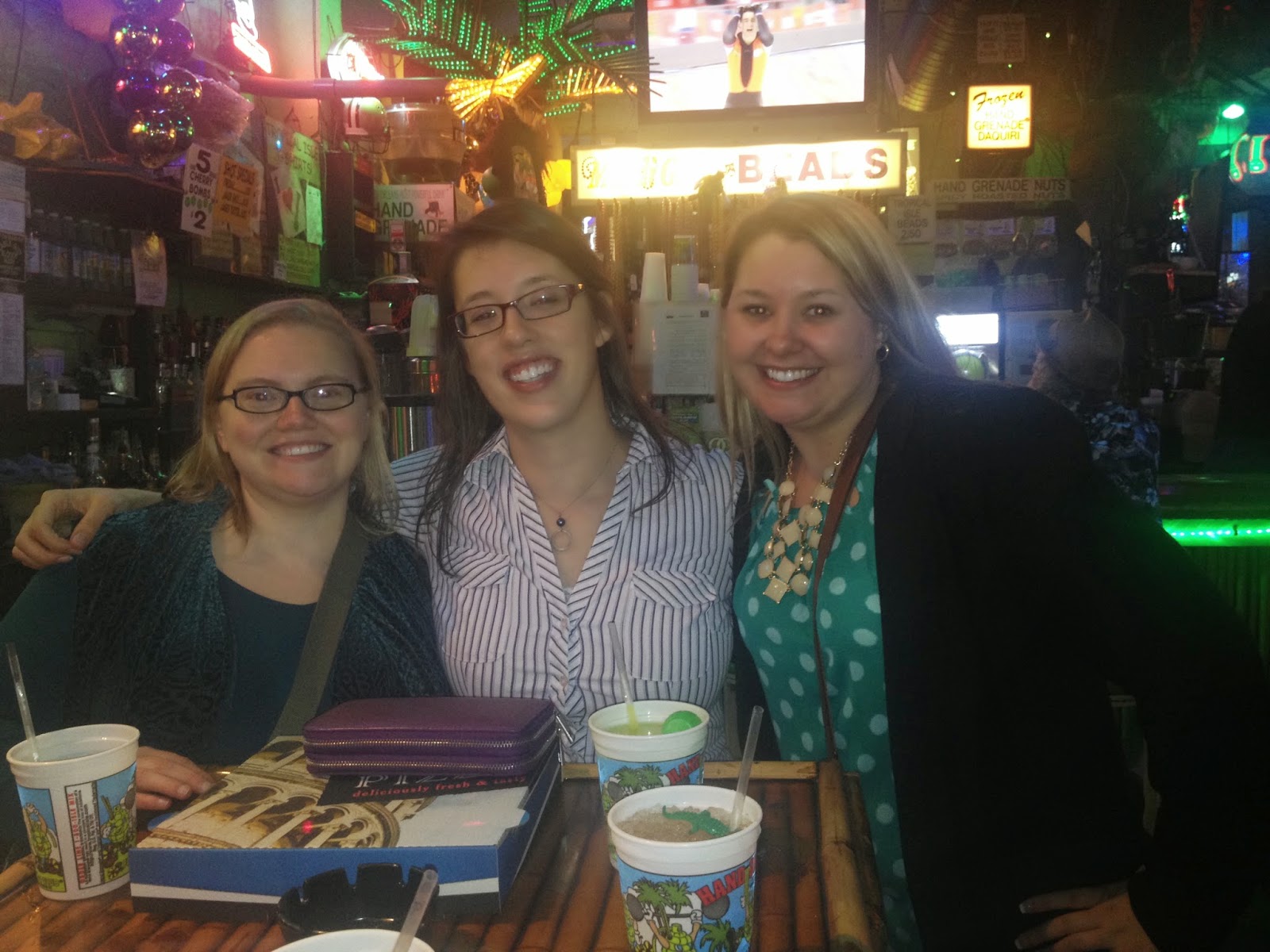
This was definitely a surprise, and I felt honored to have my hard work recognized! There is proof that maybe I'm doing something right with all this craziness. We also got to enjoy drinks with alligators, the lights going out in the rain on Bourbon street, and jazzy music on the corners. 


I'm excited for SERA 2015 in San Antonio and returning to New Orleans in the near future! :) 

Tuesday, January 28, 2014

Prelimming in Pictures

I had every intention of taking lots of pictures to document the terrible prelim experience, but it just didn't happen. 

I did take a few, though! 


Poor Jack felt deprived throughout much of the experience, but this captures how I felt most days, too. Exhausted next to a stack of read articles. 


As I said, Jack felt deprived. On the first day of prelims, I wrote for 8 straight hours and Jack hated it. On the second day, he did this...I guess he figured out how to get my attention. He was actually a great writing buddy.


And, Jack wasn't the only one feeling deprived. My boyfriend sent me this during prelims. Completely accurate, but I wonder if there is a hidden meaning here? 

Short and sweet. :) 

Sunday, January 26, 2014

Where does the time go?

In July of 2012, I was introduced to one of the most valuable tools I have utilized in graduate school so far - the Writing Log. 

I absolutely love my Writing Logs! If you are new to this concept, a Writing Log is an Excel document where you can track how much time you are spending writing, what you are writing, and where. The goal of the log is to be able to track and document progress while also keeping good writing habits. The Writing Log can be customized to your own needs and uses, and I have adapted mine several times over the last year and a half. I like to start fresh at the beginning of each month with a new log and track the hours on the right hand side of this blog. Last year, I wrote a ton, almost a month's worth. Yikes! This year, will probably be more as I will be writing my dissertation. 

In preparation for this big year, I made another change to my log (with the help of a colleague and friend). I have always wondered what percentage of my time was going to each category of project. On my log, I color-code so I can visually see where I am spending my time, but have wanted specific percentages and a better visual, like a pie chart. I separate my time into the following categories: (1) conference presentations, (2) collaborations, (3) writing projects - personal, (4) dissertation, (5) stuff for other people, (6) classes, (7) grading/teaching, and (8) ERC work. These make sense to me and help me see where I am devoting too much time. I can also see when deadlines have come and what items take priority. 

Several people have incorporated pie charts into their Writing Logs to document the progress visually, and I have wanted to do this, but being Excel-challenged, I couldn't figure it out (nor did I want to spend the time trying to figure it out). My colleague and friend figured it out for me, and now, I have a pie chart, too! I love it! The chart shows me visually where my time is being spent, but also shows the percentage of my total time spent on each project. So far in January, 77% of my time has been spent on my dissertation. I guess that's good news since I was doing my prelims which are preparation for the dissertation. :) 

The Writing Log makes life easier, and this new addition to mine will make my life even easier than before! YAY!

Wednesday, January 22, 2014

Reading About Writing - Book #1

Book #1 - Writing Your Dissertation in Fifteen Minutes a Day by Joan Bolker

This book was a recommended book for someone who is in the "dissertation-writing" phase of their program. As I am doing prelims and will soon be working on my proposal, I thought this book could give me some good ideas about breaking down the large chunks of writing a dissertation. Unfortunately, I was pretty disappointed, overall, with this book. 

When I started reading, I was expecting a book that really laid out a plan for writing about fifteen minutes a day. I'm not into prescribed plans, but I was looking forward to having a guide. Even something that broke down the chunks (i.e., research and write your theoretical framework first, then develop your methods). This book included more of a broad, over-generalization of the process and focused on some behaviors and habits to work on in order to successfully write. 

The book begins by discussing how you build a "work process" and how you pick a research topic, then covers putting together a committee. The author discusses how to manage life and contingencies, problems associated with word processors, and finally, how to publish your dissertation. None of the advice the author gives is bad, and for some people, I think this book could be really helpful. Fortunately, I had already been trained in many of the methods this author discusses and have already built a strong writing habit. Mostly, this book just reinforced what I already know but did not give me much new information.

That being said, one piece of advice the author shared that I really appreciated was the idea of a "zero draft". For as long as I can remember, my mother has hounded me about my writing progress. If she knows I have a paper or project due, she nags me and questions me about it. "Have you written your paper yet?" "What are you waiting for?" Very mother-like. My response to her is always, "It's all in my head...I've got it covered." What I mean by that statement is that I am thinking about the paper and planning what I want to write. I don't know how to explain it, but when I get an idea in my head, it has to marinate for a while. Then, suddenly, I'm ready to go. This goes back to the idea of a "zero draft". The author explains that before you can actually create your first draft, you have to create a "zero draft" of ideas, figures, or whatever helps you organize ideas. 

I think the zero draft concept can apply to many different forms of prewriting, but I just love the phrase. It is very non-intimidating and non-threatening. In a way, it gives the author permission to build his or her ideas without the pressure of having to create a formal argument or a draft of a manuscript. I love this idea. In fact, I wrote the word "zero draft" on a sticky note and stuck it to my computer as a reminder. 

While this book was not particularly useful, interesting, or eye-opening, I think it would be a great book for people who do not have a strong writing habit and need help structuring and managing their work, life, and other contingencies. Moreover, I did get one useful piece of information from this book and that is good enough for me! :)

Thursday, January 16, 2014

Prelims

The madness has begun! 

In 2014, "The Year of the Dissertation", I get to complete two of the last four big phases of this journey, start one, and do most of the work for another. Those big four phases are: (1) Preliminary Exams, (2) Dissertation Proposal, (3) Dissertation, and (4) Job!

Right now, I am working on Phase 1 - Preliminary Exams. Every department is different and none have really strict rules about these exams. The way my department chooses to do the exams is to have each committee member give the student a written component, then have all the committee members and student meet in person for the oral component. For the written part, the committee member can send the student a question (or questions) to answer in literature review format, or the committee member can have the student come in for a face-to-face exam. In the oral exam, the committee can ask anything they want of the student or can clarify for more detail about something the student wrote. There are no limitations to what the committee can ask, but if the committee knows your dissertation topic (like mine does), they try to cater to that topic.

For me, prelims began swimmingly. To put it in a nutshell, prelims consisted of me reading...a lot! I had a stack of printed articles I read through (about ~50), and I spent a few weeks getting lots of books from the library, which I read selected chapters from. I wrote a lot in journals, matrices, and on sticky notes to get my ideas together. 

One really helpful tactic I employed is the use of a timeline. As a gag gift for Christmas, my dad got me a set of huge, poster-sized Post-it notes. I always complain when I go to their house that they don't have any Post-its, which are one of my most valuable writing assets. Anyway, I actually found a good use for this large Post-it! I created a timeline with the last 5 decades on it (I went back to the 60s but have a space for anything earlier). When I read a seminal study, I wrote the author's last name and year of publication on a small sticky and placed it on the appropriate location on the timeline. I also put the theoretical frameworks that evolved during these times. Now, I can visually see a progression and how different theorists and researchers impacted the field. This has been quite useful in writing my own theoretical framework for my study.

One part of prelims that has not been nearly as easy to manage is life. The day I began working on my questions, I began noticing that I had less and less hot water available. Taking showers quickly became a race to finish before the hot water ran out...you guessed it, my water heater went out. Ha! Now, of all the inconveniences I can think of, this is one that I could certainly handle. A few cold showers never hurt anyone. BUT, the weather got a little chilly, and soon we were in 30-degree weather. That changed the game a little. Fortunately, since I was just at home writing and reading for most of the day, I could easily schedule someone to come fix the problem, and am back in "hot water" as we speak. While this was not something I wanted to handle while writing, I'm thankful it happened before school started. 

The parts of prelimming that I am thankful for is how easy it was! I was worried because people constantly told me that I wouldn't sleep or shower or eat and would neglect everything else to finish prelims. However, that was not my experience. I worked really hard the first few days of the year to write my answers to the two questions I had then I took the weekend off to play with friends and finished the questions last week. My other two committee members waived their questions, so I was done. I decided it would be good to use the extra time to read a few more articles and books I was interested in before the oral portion. It was relaxing, smooth-sailing, and very educational, even with a water heater to fix. :)

I would also like to give a public "thank you" to my friends and family and committee. They have been wonderful! Everyone was patient with me, accepted that I needed some time to complete these, and listened to me talk endlessly about everything I was learning. THANK YOU, THANK YOU, THANK YOU!

Wish me luck on the 27th! :)